Join Tuskegee Airmen Heritage in Making a Difference
Tuskegee Airmen (hiStory)
Blacks had been attempting to gain entrance into the Army Air Corps since World War I. Senators Harry Swartz of Wyoming and Styles Bridges of New Hampshire were in the forefront of those in Congress who championed the cause of blacks to serve in the Air Corps.
Public Law 18, approved April 3, 1939, provided for the large-scale expansion of the Air Corps, with one section of the law authorizing the establishment of training programs in black colleges to employ blacks in various areas of Air Corps support services.
One such college was designated as a training center for black pilots and support personnel. Race and color were not the only barriers that blacks faced in pursuit of training in the Air Corps. The fact that there were no blacks to train them meant that there must be an element of racial integration if the program were to get started.
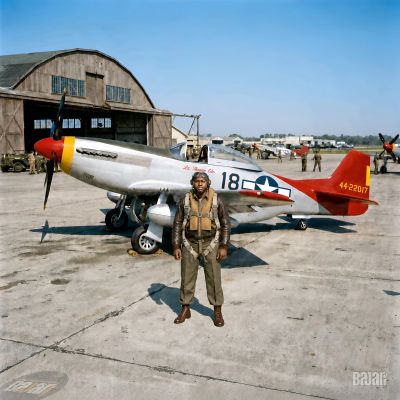
On January 16, 1941, the War Department announced the formation of the 99th Pursuit Squadron, a black flying unit, to be trained at Tuskegee, Alabama, the home of the Tuskegee Institute.
In the same month of January, the Secretary of the Army announced that, since there were no black officers in the Air Corps, 11 white officers would be assigned the duty of training 129 enlisted men and 47 officers as the first black military personnel in the flying school.
Thus, the “Lonely Eagles,” as the black pilots were to call themselves, became a reality.
World War II Achievements
The 99th Pursuit Squadron, which was later renamed the 99th Fighter Squadron, fought throughout the Mediterranean and European Theaters and became a respected group of fighter pilots. Perhaps the unit’s greatest claims to fame were: (1) as a bomber escort group that protected American bombers on their missions deep into Europe, the 99th never lost a bomber to enemy fighters, and (2) the unit was responsible for the formation of several other black Air Corps units, including fighter, bomber and composite squadrons and groups.
In June of 1943, Lieutenant Charles Hall of Indiana became the first member of the 99th to shoot down a German plane. He was personally congratulated by General Eisenhower who was in the area at the time.
From the inception of the 99the through the period that signaled the ending of World War II (1946), the following numbers of black combat flyers completed their training:
673 as single-engine pilots;
253 as twin-engine pilots;
28 as liaison field artillery officers;
132 as navigators.
The bulk of black flyers were in the 332nd Fighter Group, which consisted of the 99th Fighter Squadron; the 100th Fighter Squadron; the 301st Fighter Squadron; the 302nd Fighter Squadron; the 616th Bombardment Squadron; the 617th Bombardment Squadron; the 618th Bombardment Squadron; and the 619th Bombardment Squadron.
There was also the 477th Composite Group, which consisted of the 99th Fighter Squadron; the 616th Bombardment Squadron; the 618th Bombardment Squadron and the 619th Bombardment Squadron. The bombardment squadrons were equipped with B-26 aircraft and later with B-25s.
Campaigns of the 99th Fighter Squadron included: Sicily, Naples-Foggia, Anzio, Rome-Arno, Normandy, Northern France, Southern France, North Apennines, Rhineland, Central Europe, Po Valley, and the Air Combat-EAME Theatre.
Decorations received by the 99th Fighter Squadron were Distinguished Unit Citations for Sicily, June-July, 1943; Cassino, May 12-14, 1944; and Germany, March 24, 1945.